


Case Insight: Solving Thick Laminate Exotherm Issues
 Feb 03, 2026|
 View:454
In the world of composite manufacturing, thick laminates present unique curing challenges, particularly with respect to controlling exothermic reactions. Exotherm— the heat generated during the curing process— can be a significant issue when working with thick layers of resin, as it can lead to warping, cracking, or uneven curing. As experts in organic peroxide solutions, we understand the importance of controlling these reactions to ensure both quality and safety in production.
Ava
OP ExpertUnderstanding the Exotherm Challenge
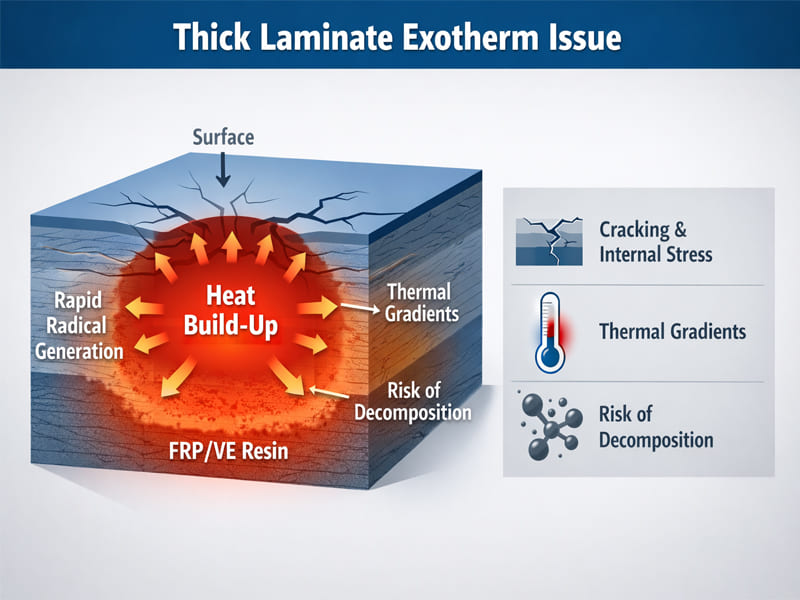
When curing thick composite laminates, especially those using unsaturated polyester resins or vinyl ester resins, the exothermic reaction can become uncontrollable if not carefully managed. This is due to the heat generated during the curing process, which, in thicker layers, is more difficult to dissipate.
Excessive heat can cause:
- Deformation or warping of the laminate
- Cracking due to thermal stress
- Incomplete curing in some areas, leading to weak spots
- Color distortion or surface imperfections
In this particular case, the customer was experiencing uneven curing and cracking in thick laminate applications used for structural parts.
Solution Approach
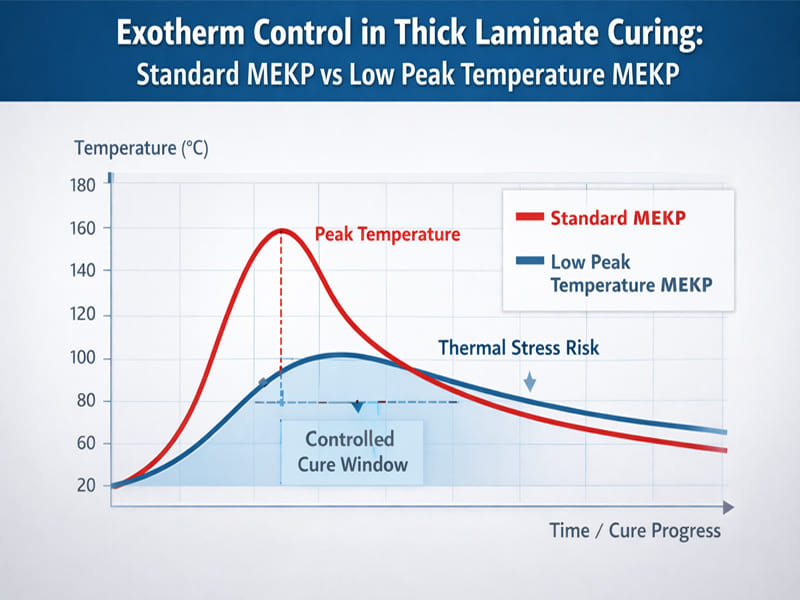
Our solution focused on selecting the right organic peroxide (MEKP) that would allow for slower, more controlled curing, reducing the overall exotherm. The key steps in the solution included:
1.Choosing the Right MEKP Formulation:
Butanox® M-50 LPT-IN, a low peak temperature MEKP, was selected. This formulation is specifically designed to extend gel time, reducing the speed of the exothermic reaction and enabling more even heat distribution across the laminate.
2.Process Optimization:
By adjusting the temperature profile and dosing techniques, we ensured that the curing process was gradual. This gave the material time to cure evenly and at a controlled pace, allowing for better heat dissipation.
3.Monitoring and Adjusting Resin Properties:
Alongside adjusting the peroxide system, we recommended modifications to the resin formula to further support a controlled exotherm. This included adjusting viscosity and adding thixotropic agents to slow the reaction and enhance the resin’s flow.
4.Temperature Control:
With thicker laminates, cooling systems were integrated into the mold setup to help prevent excessive heat buildup during the curing process.
Outcome
By implementing a low peak temperature MEKP and adjusting the process parameters, the customer was able to achieve:
-Stable curing of thick laminates with no warping or cracking
-Uniform heat distribution across the mold, ensuring the laminate remained structurally sound
-Improved surface finish with no color or texture distortion
-Reduced defects, increasing the overall yield and reducing scrap rates
This approach significantly improved both production efficiency and product quality, while also maintaining safety standards throughout the curing process.
Key Takeaways: Why Process Control Matters
Exothermic heat in thick laminates is a common challenge in the composites industry, but it is not an unsolvable one. With the right selection of MEKP initiators, process optimization, and effective heat management, manufacturers can significantly reduce the risks associated with curing thick composites.
At Evergreen Chemicals, we continue to support our customers with innovative solutions to tackle complex production challenges. Our expertise in organic peroxides, particularly Nouryon MEKP formulations, helps ensure that our customers can maintain consistent quality, efficiency, and safety in their operations.
If you’re facing similar issues in your composite production process or have questions about MEKP selection, don’t hesitate to reach out. We’re here to provide the technical guidance you need.
Recent News
1.Continuous Synthesis New Technological Process for Methyl Ethyl Ketone Peroxide (MEKP)
2024-03-292.Insight into China's MEKP Market: Key Production and Quality Metrics
2024-05-103.Navigating the World of Organic Peroxides: Best Practices for Packaging and Temperature Management of MEKP
2024-05-164.Innovative Applications of Fading MEKP and Curing Techniques for Vinyl Ester
2024-05-235.What You Need to Know About MEKP(Part Two)
2024-06-066.What is MEKP Hardener? Expert Insights from Evergreen Chemicals
2025-08-207.Organic Peroxides Explained: MEKP, DCP, BPO and TBPB
2025-12-178.Nouryon MEKP Organic Peroxides: A Practical Guide from an Industry Expert
2026-01-22


