Wind Energy Boom Is Driving Demand for MEKP and UPR Resins in 2026
 May 29, 2026|
 View:367
Hello, I’m Michael, Team Leader of the UPR Expert Database at Evergreen Chemicals and Executive Director of AOC. With 15 years in the unsaturated polyester resin (UPR) industry, I’ve led advancements in formulation and application while contributing to key industry standards and the UPR price index. I’m committed to delivering practical, market-aligned solutions that drive performance and innovation across sectors.
In wind energy composites, material selection is no longer only about cost — it is about long-term process stability, supply security, and structural reliability.
Michael
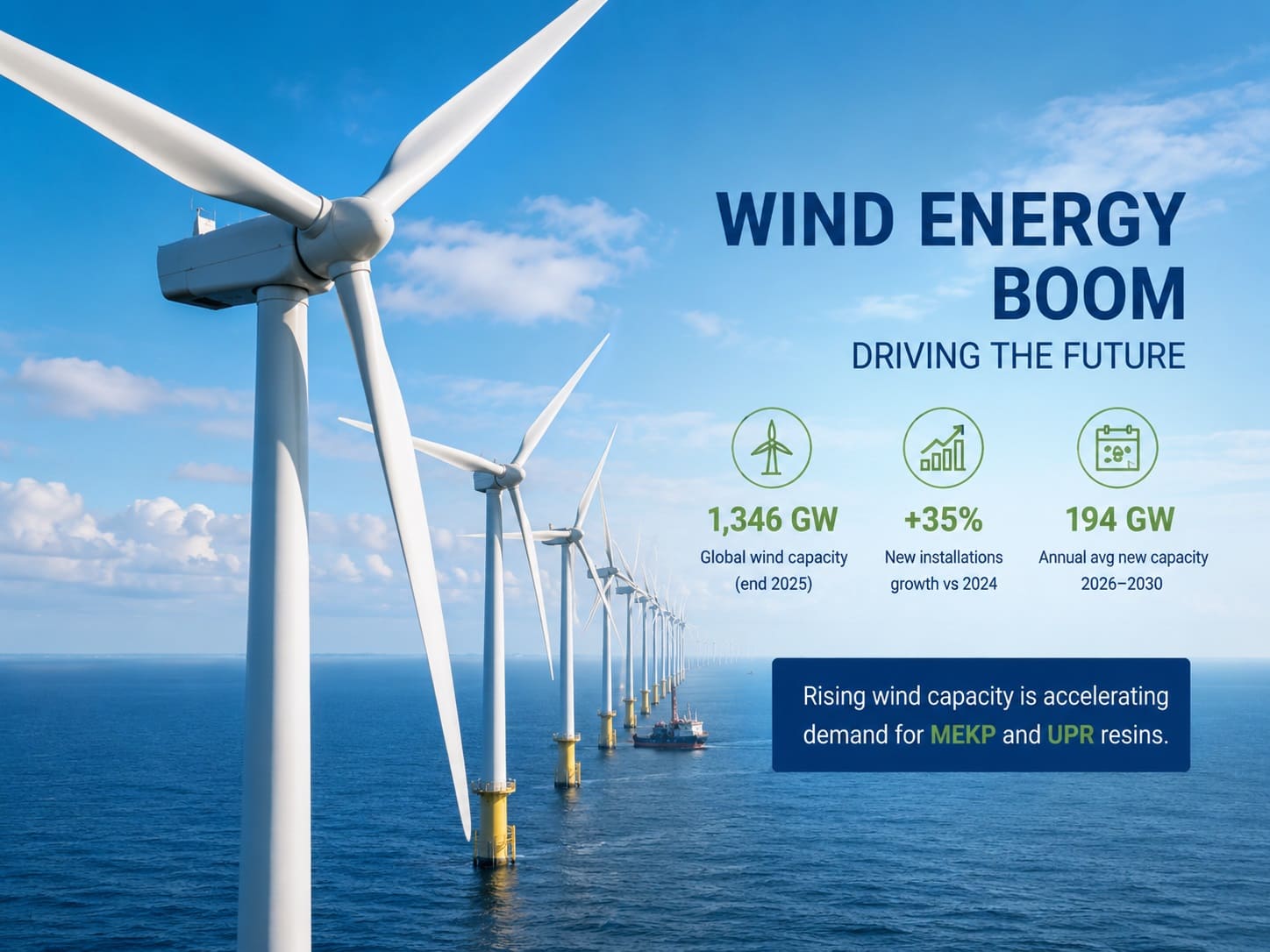
UPR ExpertThe global wind energy industry closed 2025 with its most impressive performance on record. According to the World Wind Energy Association (WWEA), total installed wind capacity surpassed 1,346 GW by year-end — a 14.3% annual growth rate, the highest since 2020. A record 169 GW of new capacity was commissioned in 2025 alone, 35% more than the previous year.
Behind these headline numbers lies a quieter but equally significant story: a surge in demand for the specialty chemical materials that make wind turbine blades possible. Chief among them are methyl ethyl ketone peroxide (MEKP) and unsaturated polyester resin (UPR) — two products that sit at the heart of fiberglass composite manufacturing.
For procurement engineers and sourcing managers in the composites supply chain, understanding this demand wave is critical for planning purchases, managing lead times, and securing supply in an increasingly competitive market.
The Wind Energy Expansion: By the Numbers
2025 was a watershed year for wind. The GWEC's 2026 Global Wind Report confirms that 165 GW of new capacity was installed across 57 countries — a 40% jump in a single year. China alone installed over 120 GW, accounting for roughly 73% of global additions. But the story extends well beyond China:
• Europe: surpassed 300 GW of total installed capacity, with 19.1 GW added in 2025.
• United States: saw onshore installations rise by approximately 7 GW, a 50% increase over 2024.
• India: became the second-largest market for new capacity additions, recording a national record of 6.3 GW.
• Middle East: emerging rapidly, with Saudi Arabia's 1,500 MW Dawadmi wind farm setting a new world record for lowest-cost wind project.
Looking forward, GWEC projects that 969 GW of new wind capacity will be commissioned between 2026 and 2030, averaging 194 GW per year. Global capacity is forecast to surpass 2 terawatts before the decade ends.
What's Inside a Wind Turbine Blade — and Why Chemistry Matters
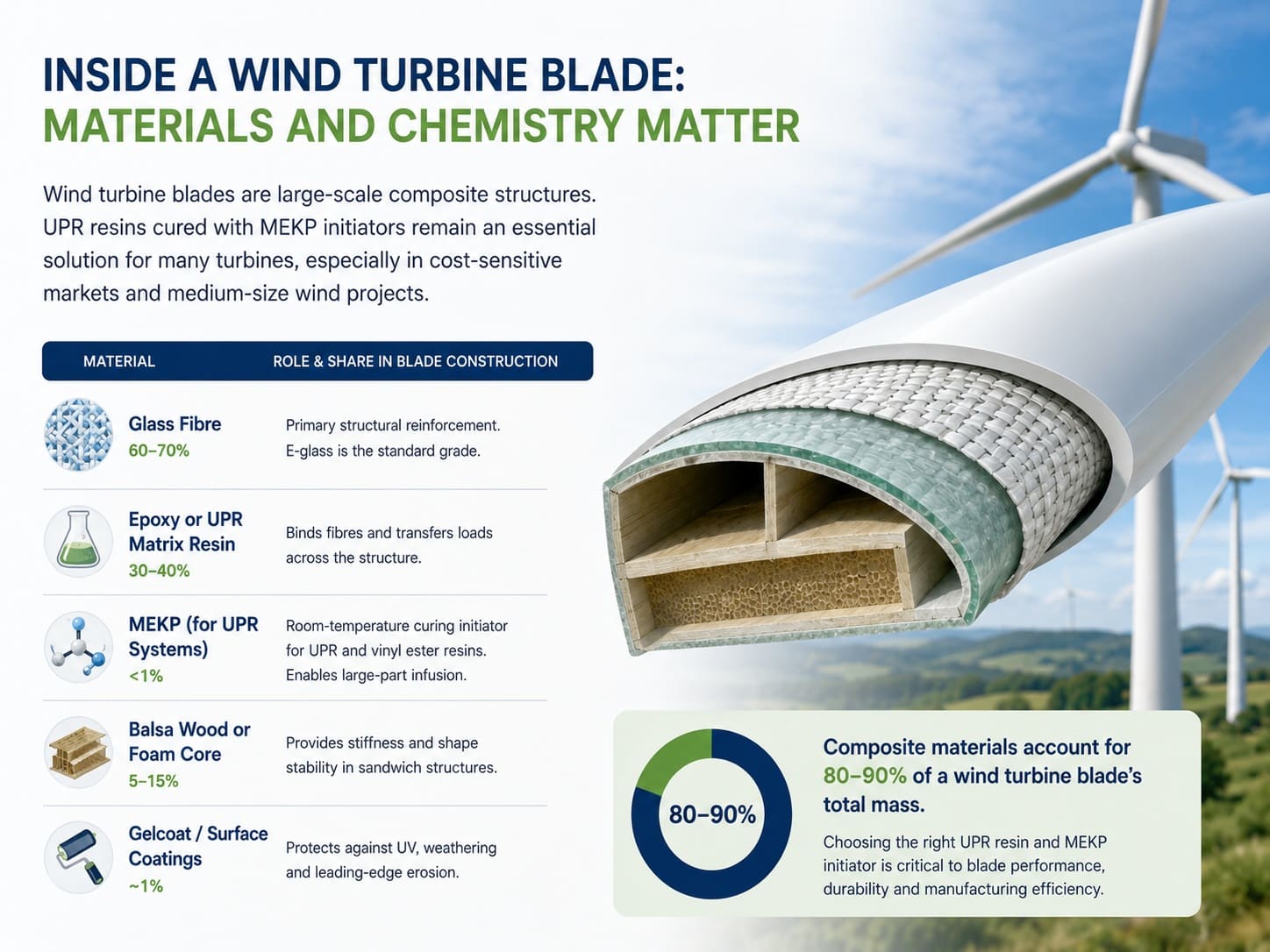
Wind turbine blades are among the largest composite structures manufactured at commercial scale. Modern onshore blades typically measure 70–90 metres in length; the newest offshore designs exceed 100 metres. Their material composition is primarily:
Material | Role & Share in Blade Construction |
Glass fibre (fiberglass) | Primary structural reinforcement. Accounts for 60–70% of composite mass. E-glass is the standard grade. |
Epoxy or UPR matrix resin | The binding agent that binds fibres and transfers loads. Resin comprises 30–40% of composite mass. |
MEKP (for UPR systems) | Room-temperature curing initiator for unsaturated polyester and vinyl ester resins. Enables large-part infusion. |
Balsa wood or foam core | Structural core material for blade sandwich panels. |
Gelcoat / surface coatings | Weather resistance, UV protection, leading-edge erosion resistance. |
According to MarketsandMarkets, approximately 82% of wind turbine blades are manufactured using epoxy resin composites, with polyester-based systems (cured with MEKP) taking a further 14% share. The remaining 4% includes vinyl ester and polyurethane systems. Between 80% and 90% of each blade's total mass is composite material — making resin chemistry the single most critical materials category in blade manufacturing.
For smaller turbines, lower-cost UPR/MEKP systems remain the material of choice due to their processing flexibility, lower raw material cost, and compatibility with hand layup and infusion manufacturing. As blade sizes scale upward and offshore applications grow, higher-performance epoxy infusion systems dominate — but MEKP retains a major role across the broader market.
How Wind Growth Translates to MEKP and UPR Demand
The MEKP Market
MEKP (methyl ethyl ketone peroxide) is the workhorse initiator for UPR and vinyl ester resin systems. It triggers the free-radical curing reaction at room temperature, making it indispensable for large composite parts where elevated-temperature oven curing is impractical.
The MEKP market was valued at approximately USD 0.9 billion in 2025 and is projected to reach USD 0.9 billion by 2034 at a CAGR of 6.0%, with the wind energy sector identified as a primary demand driver. Europe consumes around 25% of the global MEKP market, with Germany alone holding a 7% global share driven by its automotive and industrial composites sectors. The UK is experiencing one of the fastest MEKP growth rates regionally, powered by offshore wind blade manufacturing.
The UPR Market
Unsaturated polyester resin (UPR) is the base matrix resin in MEKP-cured composite systems. The global organic peroxide market — of which MEKP is a major segment — was valued at USD 2.39 billion in 2025 and is projected to reach USD 3.59 billion by 2035 at a 4.3% CAGR. Among the key demand drivers cited by Global Market Insights: the expansion of high-performance composites in wind energy.
For wind energy applications, isophthalic UPR grades are typically preferred over orthophthalic grades due to their superior hydrolytic resistance — a critical property for blades exposed to rain, humidity, and temperature cycling over a 20–25 year service life. Dicyclopentadiene (DCPD) grades are also used in some applications for their improved surface finish and lower cost.
Key UPR suppliers for the wind energy market include AOC Resins, Swancor (with their Chempulse 901 and 977 series), Scott Bader, and Reichhold. The choice of resin grade, viscosity profile, and gel time are all process-critical decisions that affect blade manufacturing throughput and final part quality.
Offshore Wind: The Next Demand Amplifier
While onshore wind drove the 2025 records, offshore wind represents the structural long-term growth vector for composite material demand. Offshore turbines are significantly larger than their onshore counterparts — current generation offshore platforms such as Vestas' V236-15.0 MW turbine feature blades exceeding 115 metres in length. Each blade on a single 15 MW offshore turbine contains substantially more composite material than an entire set of blades on a typical 3–4 MW onshore machine.
80 GW Offshore wind installed globally (2025) | 150 GW Offshore wind under development (2025) | $109B Offshore wind market value 2026 (USD) |
The offshore wind market is forecast to grow from USD 109 billion in 2026 to USD 307.5 billion by 2035, a CAGR of 12.2%. China, which has grown its offshore wind capacity from less than 5 GW in 2018 to over 42.7 GW today, continues to dominate — but Europe and the Middle East are investing aggressively.
For material suppliers, offshore growth means one thing: per-turbine resin and initiator consumption will increase significantly as average turbine size rises. A single 100-metre blade can consume 8–12 tonnes of resin in its composite structure. At 194 GW of annual new capacity projected through 2030, the demand signal is unambiguous.
Supply Chain Considerations for 2026 and Beyond
Strong demand fundamentals do not automatically translate into easy procurement. Several supply chain dynamics deserve attention from composites buyers:
Raw material feedstock pressures
MEKP is synthesised from methyl ethyl ketone (MEK) and hydrogen peroxide. Both feedstocks are subject to petrochemical market volatility. MEK prices track benzene and butane markets; hydrogen peroxide capacity has been constrained in some regions following plant consolidation. Buyers should monitor feedstock pricing as a leading indicator of MEKP price movements.
Organic peroxide logistics
MEKP and other organic peroxides are temperature-sensitive and require refrigerated or controlled-temperature storage and transport. Supply chains from Asian manufacturers to European or North American wind blade factories involve complex cold-chain logistics that add lead time and cost. Ensuring your distributor has the appropriate IMDG/ADR certifications and cold storage infrastructure is non-negotiable.
Grade selection for large-blade infusion
Not all MEKP grades are interchangeable. High-reactivity grades (e.g., Butanox M-50, Trigonox 93) are designed for rapid room-temperature cure in thin laminates. Large-blade vacuum infusion processes require specifically formulated low-activity grades with extended pot life. Selecting the wrong grade can lead to premature gelation, voids, or incomplete cure — all of which compromise structural integrity.
Geopolitical and tariff exposure
A significant share of global fiberglass and resin production is concentrated in China and Taiwan. Trade policy developments — including US Section 301 tariffs and EU carbon border adjustment mechanisms — introduce pricing uncertainty for buyers in Western markets. Diversifying supply sources and working with distributors who can offer flexible sourcing is increasingly important.
What This Means for Your Procurement Strategy
For procurement teams and materials engineers sourcing MEKP, UPR, and fiberglass for wind energy composite applications, several practical steps are worth considering in 2026:
• Secure frame agreements early. With demand projections pointing upward through 2030, spot market availability for specialty MEKP grades will tighten. Frame agreements with quarterly price reviews protect volume while managing cost exposure.
• Qualify alternative grades. Qualify at least two MEKP grades from different manufacturers for your key processes. Grade qualification takes time — starting now avoids forced substitutions during supply disruptions.
• Engage your distributor as a technical partner. The right MEKP grade for a 70-metre blade infusion differs from what works in a boat hull or tank. Work with distributors who can provide technical datasheets, application support, and access to manufacturer engineering teams.
• Monitor sustainability requirements. European wind OEMs are increasingly requiring low-VOC and low-styrene-emission resin systems as part of their ESG commitments. Understanding which grades meet these requirements positions you ahead of upcoming specifications.
• Plan for logistics lead time. Cold-chain shipments from Asia to Europe typically take 5–7 weeks door-to-door. Build this into your safety stock calculations, particularly for Q3 peak commissioning seasons.
Conclusion
The wind energy boom is real, it is accelerating, and its material consequences are already visible in specialist chemicals markets. With 169 GW installed in 2025 and nearly 200 GW projected annually through 2030, the demand for MEKP, UPR, and glass fibre will continue to rise. Procurement teams who understand the chemistry, plan ahead, and work with technically capable distribution partners will be best positioned to keep their manufacturing lines running at the pace the energy transition demands.